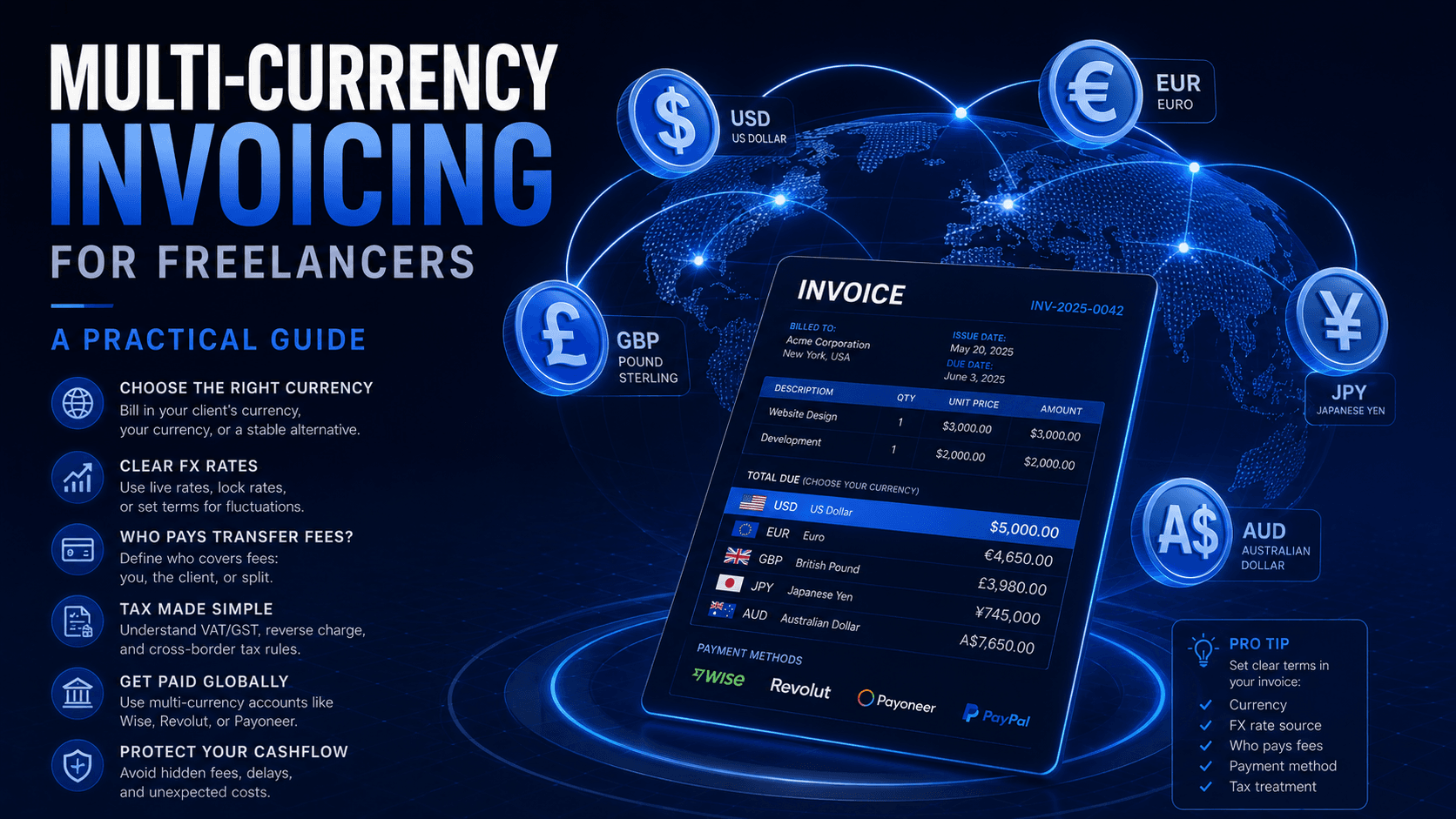
Landing your first international client in the United States, United Kingdom, or European Union is an exciting milestone. Then reality hits: What currency do you put on the invoice? How do you avoid losing 5% in predatory PayPal exchange fees? What does your US client mean when they request a W-8BEN form? And why did your client's accounts department bounce your invoice because it lacked an IBAN or SWIFT code?
If you freelance from South Asia (Pakistan, India, Bangladesh), Southeast Asia (Philippines, Indonesia), Latin America, or Africa, getting paid internationally is half the job. Here is a practical, field-tested guide to invoicing global clients without friction or excessive banking deductions.
TL;DR — The Golden Rules of International Invoicing in 2026
- Currency Rule: Always denominate the invoice in the client's currency (USD for US clients, GBP for UK clients, EUR for EU clients) unless explicitly negotiated otherwise in writing.
- Payment Rail Rule: Never rely on standard consumer PayPal for cross-border B2B payments; you will lose 4.5% to 6% to currency spread. Use Wise Business or Payoneer receiving accounts.
- Tax Compliance Rule: Non-US freelancers billing US companies must complete IRS Form W-8BEN once per engagement to exempt their earnings from 30% US withholding tax.
- Document Hygiene Rule: An international invoice must include your full legal address with country code, complete SWIFT/BIC codes, and payment settlement instructions.
The 4 Hard Questions Before You Send an International Invoice
Before generating your invoice, resolve these four structural questions with your client:
- 011. What currency are we settling in? Never bill an American client in INR or PKR; accounts payable teams will reject documents that force them to calculate exchange rates manually.
- 022. Which payment method minimizes transfer fees for both sides? Recommend Wise virtual ACH routing numbers or local SEPA accounts so the client pays as if you were local.
- 033. Who covers intermediary banking fees? Include a standard payment clause: 'Client is responsible for all sender bank wire transfer fees; net receivable must match invoice total.'
- 044. Does the client require a tax declaration or vendor registration form before processing?
Payment Methods Compared: Real Fees and Math
The payment method you choose significantly impacts your net earnings. Here is what happens when a US client pays you $3,000:
- Wise (TransferWise): Client sends $3,000 via local US ACH transfer to your Wise USD account (fee: $0.39). You convert to local currency at mid-market rate with a transparent 0.4%–0.7% fee. You receive ~$2,980 worth of local currency.
- Payoneer: Client pays via US ACH receiving account (fee: 1%–2%). Payoneer charges 2% on withdrawal to your local bank. You receive ~$2,920.
- Direct International Wire (SWIFT): Client's bank charges $25–$45 sending fee; intermediary correspondent banks deduct $20; your receiving bank charges a landing fee and offers a poor retail exchange rate. You receive ~$2,850.
- PayPal: Charges 3.49% standard merchant fee + 1.5% international cross-border fee + a hidden 3%–4% spread on currency conversion. On $3,000, you easily surrender $200–$250 in unnecessary leakage.
Tax & Compliance Notes on Cross-Border Invoices
International tax law sounds intimidating, but for independent remote freelancers, it reduces to three primary scenarios:
- United States (IRS Form W-8BEN): US companies are legally required to collect a signed Form W-8BEN ('Certificate of Foreign Status of Beneficial Owner for United States Tax Withholding') from foreign independent contractors. This form proves you perform work outside the United States and ensures zero tax is withheld from your invoice.
- European Union (VAT Reverse Charge): If you are billing a VAT-registered business inside the EU, include their VAT number and the phrase: 'VAT reverse charge applies; services rendered outside EU territory.'
- Domestic Export Invoicing (Pakistan PSEB / India FEMA): If you operate in Pakistan, register with PSEB to enjoy IT export tax exemptions and retain foreign currency. In India, ensure inward remittances receive a Foreign Inward Remittance Certificate (FIRC).
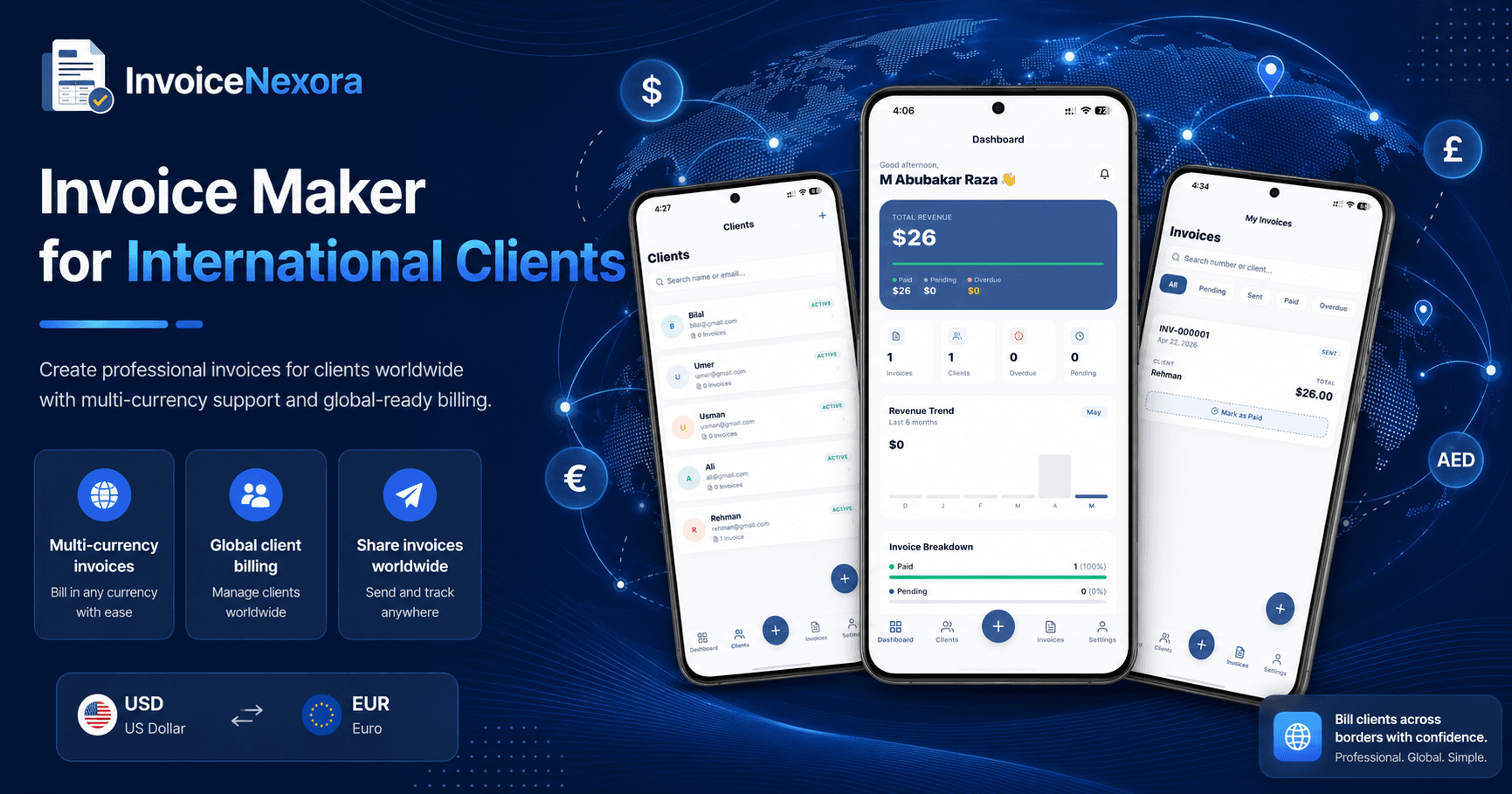
InvoiceNexora: Built for International Freelancers
InvoiceNexora was designed specifically to support cross-border freelance workflows:
- 100+ Currency Symbols: Toggle between USD ($), EUR (€), GBP (£), AUD (A$), CAD (C$), AED, and dozens of global currencies on a per-client basis.
- Custom Payment Footers: Save full international bank coordinates (SWIFT/BIC, IBAN, Wise account, routing numbers) directly in your default payment terms.
- High-DPI Professional PDFs: Deliver crisp, branded vector documents that satisfy corporate accounts payable and audit compliance standards.
Download the app
Send branded, professional invoices in under a minute.
Mobile-first invoicing for freelancers and small businesses. Templates, clients, multi-currency, and clear payment tracking - all from your phone. This article is only the plan. The app is the shortcut.